
Call for Applications
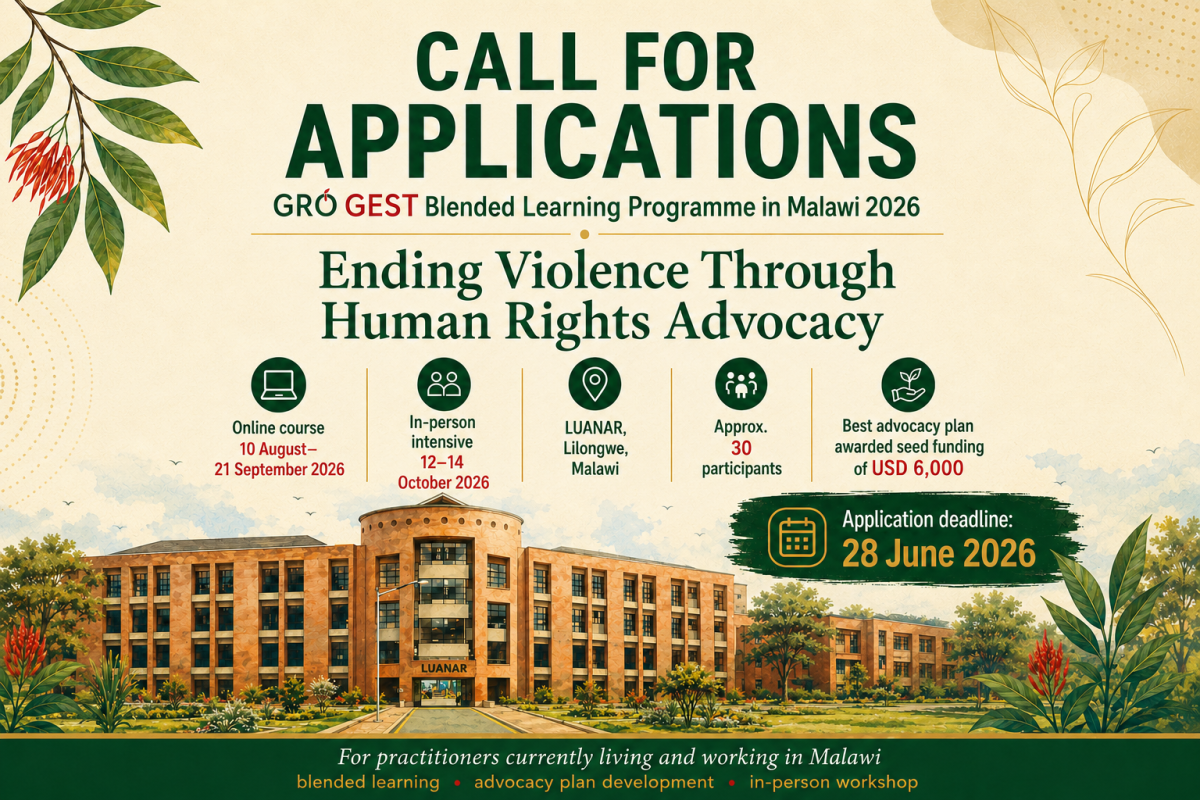
Online course: 10 August–21 September 2026
In-person intensive: 12–14 October 2026, LUANAR, Lilongwe, Malawi
Go to application form – Deadline: 28 June 2026
Make sure you read the full call below before applying!!!
The GRÓ Gender Equality Studies and Training (GEST) Programme at the University of Iceland, the Embassy of Iceland in Lilongwe, and Lilongwe University of Agriculture and Natural Resources (LUANAR) invite applications for a blended learning programme in Malawi linked to the launch of GRÓ GEST’s new online course Ending Violence Through Human Rights Advocacy.
This programme combines a six-week online course with an in-person intensive workshop at LUANAR in Lilongwe. It is designed for practitioners in Malawi who want to strengthen their ability to use human-rights frameworks, gender-transformative approaches, and practical advocacy strategies to prevent violence, with particular attention to men, boys, masculinities, and gendered power structures.
The programme will support approximately 30 participants to complete the online course, develop a concrete advocacy plan connected to their current organisational, workplace, or community role, and receive feedback from leading practitioners in the field. The in-person workshop will be led by Dean Peacock and Angelica Pino, who are also the instructors of the online course.
At the end of the programme, the best advocacy plan will be selected for seed funding of USD 6,000, provided through the applicant’s organisation, with the individual participant serving as the designated project manager. Selection into the programme does not guarantee seed funding.
Programme Overview
Ending Violence Through Human Rights Advocacy is a new GRÓ GEST online course that supports learners to analyse violence not only as individual behaviour, but as a structural, political, and human-rights issue. The course examines the role of gendered power, masculinities, political economy, institutional accountability, and international and regional human-rights frameworks in efforts to prevent violence.
The Malawi blended learning rollout is intended to move beyond training as a stand-alone activity. Participants will be expected to use the programme to develop an advocacy plan that is relevant to their current work and realistic within their institutional, organisational, workplace, or community context.
The programme is particularly suited for applicants who are already working in areas related to gender equality, violence prevention, human rights, youth or community mobilisation, SRHR, peacebuilding, justice, disability inclusion, refugee or displaced community support, workplace inclusion, safeguarding, or other relevant forms of rights-based advocacy.
Programme Structure
The programme has three main phases.
Phase I: Online Course
10 August–21 September 2026
Participants will complete the online course Ending Violence Through Human Rights Advocacy. The course can be completed at participants’ own pace during the online period, but there will also be fixed live sessions. Participation in live sessions is strongly encouraged.
The online course will introduce participants to key concepts, tools, and frameworks for understanding and addressing violence through human-rights advocacy. Participants will engage with course materials, complete learning activities, participate in discussions and peer exchange, and begin developing an advocacy plan connected to their own work.
Phase II: Advocacy Plan Development
22 September–11 October 2026
After completing the online course, participants will have three weeks to continue developing their advocacy plans. These plans should be grounded in the applicant’s professional or organisational context and should identify a realistic issue, advocacy goal, relevant stakeholders or decision-makers, and potential pathways for implementation.
The advocacy plan does not need to be fully developed at the time of application. However, applicants must submit a preliminary advocacy idea that demonstrates relevance, realism, contextual grounding, and potential for further development.
Phase III: In-Person Intensive Workshop
12–14 October 2026, LUANAR, Lilongwe
Participants who successfully complete the online course and submit a draft advocacy plan will be invited to attend the three-day in-person intensive workshop at LUANAR in Lilongwe.
The workshop will be led by instructors Dean Peacock and Angelica Pino. Through exercises, discussion, peer learning, and expert feedback, participants will strengthen their advocacy plans and consider how these can be implemented in ways that are strategic, ethical, inclusive, realistic, and grounded in do-no-harm principles.
Failure to complete the online course and submit the draft advocacy plan will lead to exclusion from the in-person workshop.
After the in-person workshop, participants will have additional time to finalise their advocacy plans. The final advocacy plan must be submitted by 1 November 2026. In November, the Embassy of Iceland in Lilongwe will host a ceremony where the best advocacy plan will be announced.
Seed Funding Opportunity
The best final advocacy plan will receive seed funding of USD 6,000.
The seed funding is intended to support early implementation of a realistic and high-quality advocacy initiative developed through the programme. The funding will be awarded to the participant’s organisation, with the individual participant designated as the project manager. The organisation will not be permitted to reallocate the funding to other activities. These conditions will be stipulated in a grant agreement.
Seed funding decisions will be based on the quality, feasibility, implementation readiness, organisational anchoring, advocacy relevance, and strategic impact potential of the final advocacy plan.
Selection into the blended learning programme does not guarantee seed funding.
Who Can Apply?
Applicants must currently live and work in Malawi. There are no exceptions to this requirement.
Applicants should be working in a field relevant to violence prevention, gender equality, human rights, advocacy, community mobilisation, institutional change, or related areas. Applications are welcome from individuals working in: NGOs, civil society organisations, and community-based organisations; government institutions; private-sector institutions; research institutes and universities; professional associations; advocacy networks and movements; faith-based, traditional, or community structures; UN agencies or international organisations; and other relevant organisations or initiatives.
Applications are also encouraged from applicants working in or with constituencies that are often underrepresented in violence prevention and gender equality programming, including persons with disabilities, refugee, displaced, or migrant communities, rural communities, youth, smaller community-based organisations, and other marginalised or underrepresented groups.
Applications from the private sector are also encouraged, particularly from individuals working on gender mainstreaming, workplace inclusion, safeguarding, employee wellbeing, corporate social responsibility, institutional culture, or related areas.
The programme will prioritise emerging and mid-career practitioners, especially applicants approximately between the ages of 25 and 45, where this supports the programme’s aim of strengthening long-term advocacy capacity. However, age is not a strict eligibility requirement.
Institutional Support
Applicants may apply as individuals, but they must demonstrate clear institutional anchoring. This means that the proposed advocacy plan should be connected to the applicant’s current organisational, workplace, professional, or community role.
Each applicant must upload a formal institutional support letter as part of the application form. The letter must be signed by a supervisor, director, head of organisation, or equivalent institutional representative.
The letter must confirm the organisation’s support for the applicant’s participation, permission to participate during working hours, including the in-person workshop in Lilongwe, the organisational relevance of the proposed advocacy initiative, willingness to support implementation of the advocacy plan after the programme, and how the proposed advocacy work connects to the organisation’s mandate, programmes, workplace responsibilities, community engagement, or strategic priorities.
Applications without a sufficient institutional support letter will not be considered.
Selection Criteria
Eligible applications will be assessed through a competitive selection process conducted by GRÓ GEST and programme partners.
Priority will be given to applicants who demonstrate strong motivation, relevant professional positioning, institutional support, and realistic potential to apply the learning after the programme. The selection process will not primarily prioritise academic credentials, highly technical proposal-writing language, or organisational prestige.
Applications will be assessed according to the following criteria:
- Institutional anchoring and organisational support: The strength and credibility of the applicant’s institutional support, the connection between the applicant’s role and the proposed advocacy plan, and the likelihood that the work can be carried forward within the organisation, workplace, network, or community.
- Feasibility and implementation readiness: The clarity, relevance, realism, and practical grounding of the proposed advocacy idea. Simple and implementable ideas may be prioritised over ambitious proposals that are not sufficiently grounded in the applicant’s context.
- Relevance to violence prevention and engagement with men, boys, masculinities, or gendered power structures: Applicants do not need prior specialist experience working with men and boys, but their proposed advocacy idea should engage meaningfully with the themes of the programme.
- Applicant capacity and positioning: The applicant’s current role, relevant experience, motivation, communication skills, ability to participate in online learning, and potential to apply the learning in practice.
- Potential for broader organisational or community impact: The extent to which the advocacy plan could influence wider programmes, institutions, networks, communities, or policy processes.
- Contribution to cohort diversity: The programme seeks a diverse cohort across sectors, regions, institutional types, advocacy approaches, and constituencies.
Practical Information
The online course will run from 10 August to 21 September 2026. The in-person intensive workshop will take place at LUANAR in Lilongwe from 12–14 October 2026.
Participants must be able to complete the online course, participate in fixed live sessions where possible, submit a draft advocacy plan before the workshop, attend the full three-day in-person workshop, and submit a final advocacy plan by 1 November 2026.
Participants are responsible for their own travel, accommodation, and other costs related to attending the in-person workshop in Lilongwe. Meals and refreshments will be provided during the daytime sessions of the in-person intensive workshop.
The programme will be delivered in English. Applicants must have sufficient written and spoken English proficiency to complete the online course, participate in discussions, and develop their advocacy plan in English. Applicants must also have reliable internet access, access to a suitable digital device, and sufficient digital literacy to complete the online component independently.
About the Instructors
Dean Peacock has worked for more than three decades in South Africa, across Africa, the Americas, and globally to prevent violence, promote peace, advance gender equality and human rights, and strengthen organisational capacity. He co-founded the MenEngage Alliance and Sonke Gender Justice, has worked extensively with civil society organisations, governments, academic institutions, and United Nations agencies, and has directed a sixteen-country initiative on men, masculinities, militarism, and peace at the Women’s International League for Peace and Freedom.
Angelica Pino is a feminist lawyer and human-rights practitioner originally from Chile and based in Johannesburg. She has worked for decades on women’s rights, gender-based violence, feminist networks, legal empowerment, and violence prevention in Latin America and Southern Africa. She has held roles with organisations including the Nisaa Institute for Women’s Development, Heinrich Böll Foundation Southern Africa, the Centre for the Study of Violence and Reconciliation, Gender Links, Sonke Gender Justice, the Sexual Violence Research Initiative, and the Women’s International League for Peace and Freedom.
How to Apply
Applications must be submitted through the online application form.
Application deadline: 28 June 2026
Applicants will be notified of the outcome by 20 July 2026.
The application form requires applicants to provide information about their professional background, organisational affiliation, current work, availability, English proficiency, digital access, preliminary advocacy idea, and institutional support. Applicants must upload a formal institutional support letter as part of the application.
Applications submitted outside the online form will not be considered.
For questions, please contact tbs@hi.is.