
New GRÓ GEST Course Launches
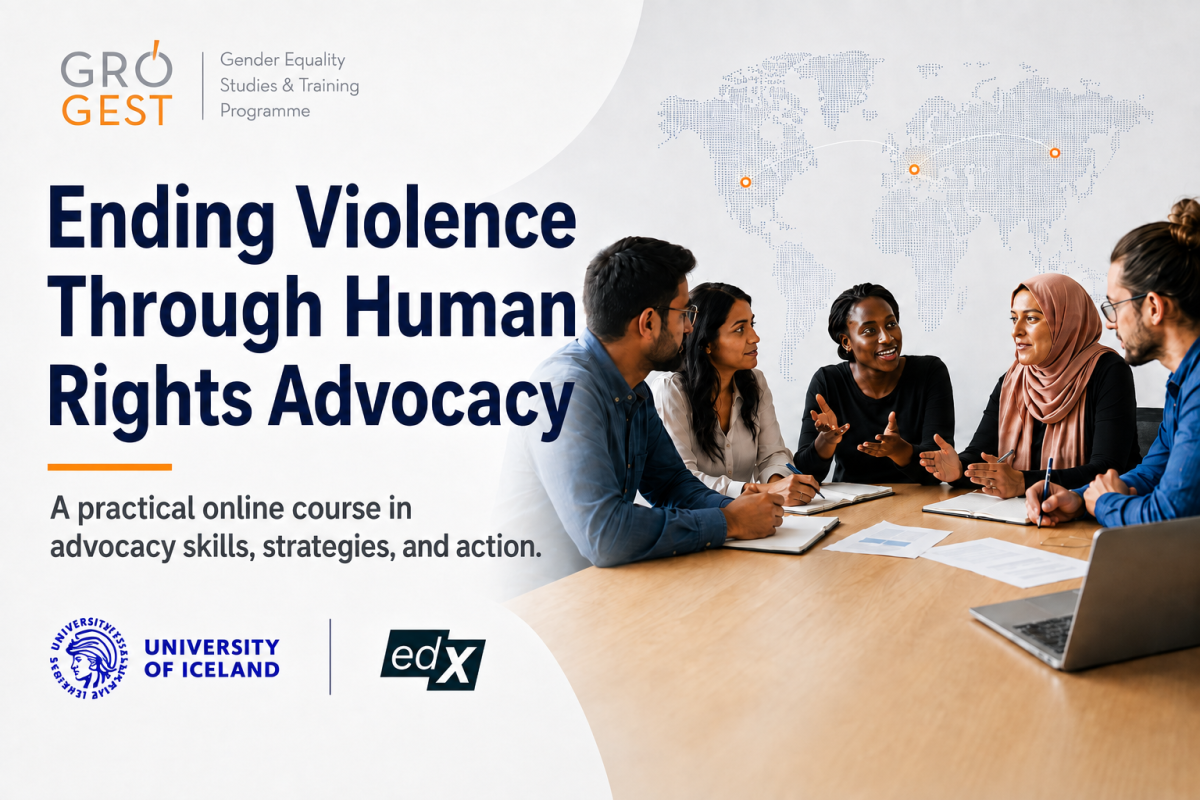
GRÓ GEST will launch its new global online course, Ending Violence through Human Rights Advocacy, on 10 August 2026 at 8:00 EAT. Enrol here.
Designed for professionals working on gender equality, human rights, violence prevention and peacebuilding, the course examines how gender-based violence is connected to power, masculinities, conflict, militarisation, institutions, law, policy and social norms. At the heart of the course is the development of a Capstone Advocacy Plan: a practical strategy that learners can use to address a specific problem in their own organisation, institution or community.
The fully self-paced course will be available worldwide, and enrolment will remain open after the launch date. Its first run continues until 11 October. Audit access is free and lasts nine weeks, while the Verified track is available for USD 5 for this launch only. Verified learners receive an edX certificate signed by GRÓ GEST Director Dr Irma Jóhanna Erlingsdóttir and Senior Programme Manager Dr Thomas Brorsen Smidt, as well as continued access to the course after the active run.
A course built around practice
Across five modules, learners examine violence as a structural and political problem rather than simply a matter of individual behaviour. They explore the political economy of masculinities and violence, feminist and decolonial approaches to engaging men and boys, and accountability to women’s rights movements and affected communities. They then work with international and regional human-rights mechanisms before developing an advocacy strategy grounded in their own context.
A central premise of the course is that men are not inherently violent and that prevention cannot be reduced to “fixing” individual men. Instead, the course investigates how institutions, histories, economies and gender orders can produce, reward and normalise harmful forms of masculinity. It also considers how men can contribute as accountable allies without recentring men or displacing feminist leadership.
The course requires approximately 40 hours of study and deliberately goes beyond passive video learning. Thirty instructor-led videos are combined with readings, regional case studies, visual summaries, interactive knowledge checks, drag-and-drop activities, a structured course journal and applied assignments assessed through peer review.
The journal asks learners to apply the curriculum to a problem in their own institutional or community setting. Successive exercises help them analyse structural drivers, identify relevant rights frameworks, map stakeholders and develop a realistic advocacy objective. Peer review adds a transnational dimension, exposing learners to work from different political and regional contexts while strengthening their ability to assess advocacy proposals constructively.
The main practical product is a Capstone Advocacy Plan. It is not part of the numerical course grade, but a usable strategy bringing together analysis, evidence, rights frameworks, stakeholder mapping, advocacy methods and plans for monitoring and adaptation. All learners receive a journal, bibliography, capstone workbook and drafting templates to support the process.
“Our aim was to avoid creating a course in which learners simply watch experts and passively take in information,” said Dr Thomas Brorsen Smidt, course director and lead learning designer. “Every stage asks learners to interpret, test, map, compare or apply what they are learning. The journal, peer-reviewed assignments and capstone process are designed so that learners finish not only with stronger knowledge, but with an advocacy strategy they can begin using in their own work.”
Global expertise in one learning journey
The course was developed and is delivered by GRÓ GEST, with contributing expertise from the Women’s International League for Peace and Freedom, the University of Cape Town and Stellenbosch University.
Its three principal instructors bring complementary experience in activism, scholarship, feminist peace and violence prevention. Dean Peacock is Honorary Senior Lecturer at the University of Cape Town’s School of Public Health. Angelica Pino is Program Coordinator at the Women’s International League for Peace and Freedom. Professor Kopano Ratele of Stellenbosch University is an internationally recognised scholar of masculinities and African-centred decolonial psychologies. Dr Thomas Brorsen Smidt directed the course and designed its learning architecture for the edX platform.
Script development began in late 2024. In November 2025, the instructors gathered in Cape Town for rehearsals and two intensive filming days with South African production company KNOWN, producing thirty educational videos and the course trailer. During spring 2026, the material was transformed into a complete edX learning experience, with activities, assessments and practical tools designed to support sustained engagement.
“This course reflects GRÓ GEST’s commitment to education that is globally accessible while remaining closely connected to professional practice,” said Dr Irma Jóhanna Erlingsdóttir. “Learners are not only introduced to important feminist and human-rights frameworks. They are supported in asking what those frameworks can do in a particular institution, community or political context, and in developing a realistic plan for putting them to work.”
A global launch anchored in Malawi
The launch will also provide the online foundation for the first GRÓ GEST blended programme built around the course. Almost 100 people applied for the Malawi initiative, from which 40 emerging and mid-career equality advocates and professionals were selected from the country’s Central, Northern and Southern regions.
After completing the online component, participants will meet for a three-day intensive at Lilongwe University of Agriculture and Natural Resources from 12 to 14 October. The programme is organised with LUANAR and the Embassy of Iceland. Each participant will develop a Capstone Advocacy Plan connected to an issue in their organisation, institution or community. The strongest final plan will receive USD 6,000 in seed funding to support early implementation through the participant’s organisation.
Further blended-learning applications are being developed through GRÓ GEST alumni in Pakistan later in 2026 and again in Malawi in 2027. GRÓ GEST is also exploring a Ukrainian-language version for practitioners in Ukraine under its cooperation framework with the High School of Public Governance of Ukraine.
Ending Violence through Human Rights Advocacy opens on 10 August. Learners and organisations are encouraged to enrol through edX and share the course with colleagues, students, partners and professional networks working to prevent violence and advance gender equality and human rights.