
GEST Alumni-Led Webinar
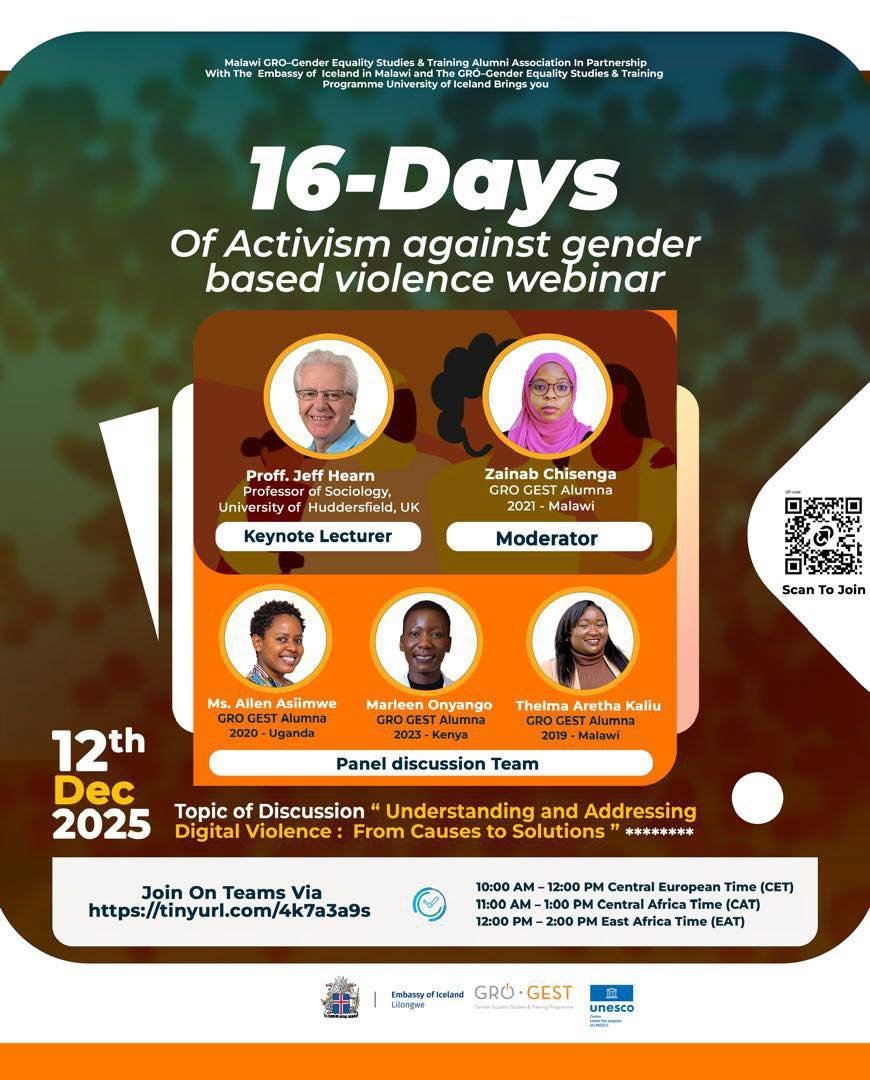
On 12 December 2025, GRÓ GEST alumni and partners convened online for a regional seminar titled Understanding and Addressing Digital Violence: From Causes to Solutions, held as part of the global 16 Days of Activism against Gender-Based Violence. The webinar was hosted by the Malawi GRÓ GEST Alumni Association in partnership with the Embassy of Iceland in Malawi and the GRÓ Gender Equality Studies and Training (GEST) Programme at the University of Iceland. A total of 43 participants from across the GRÓ ecosystem took part, reflecting strong alumni and partner engagement across countries and sectors.
The seminar formed part of the UNiTE campaign theme UNiTE to End Digital Violence against All Women and Girls and focused on the growing scale and complexity of technology-facilitated gender-based violence in Eastern and Southern Africa.
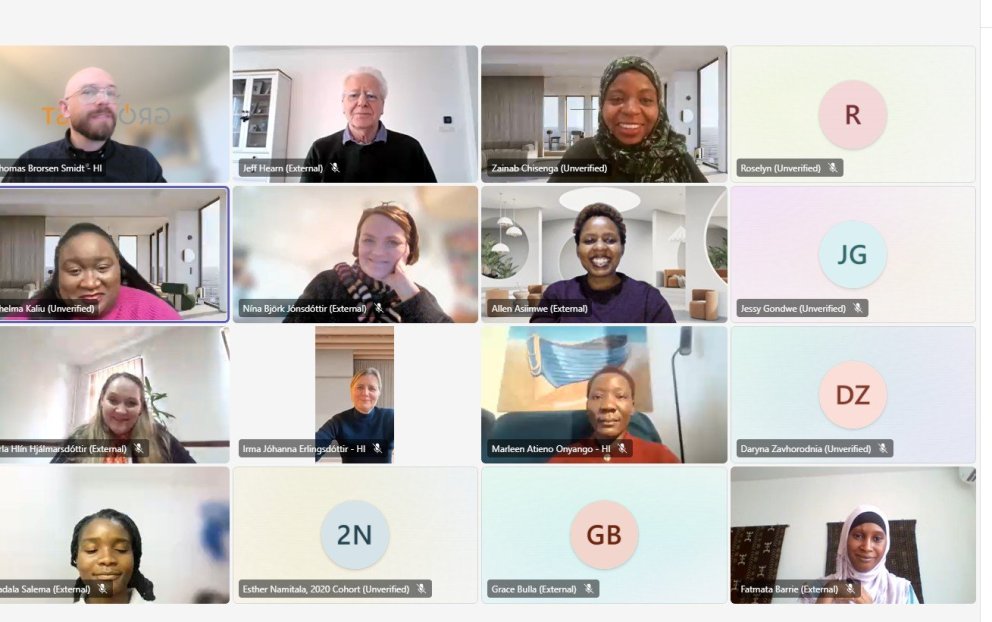
The event brought together academic expertise, alumni-led regional knowledge, and institutional partnership, with the Director of GRÓ GEST, Irma Erlingsdóttir and Director General of GRÓ, Nína Björk Jónsdóttir also in attendance, underscoring GRÓ’s strong institutional support for alumni-led initiatives and regional dialogue.
Opening and framing of the seminar
The seminar was opened and moderated throughout by Zainab Chisenga, GRÓ GEST alumna (2021, Malawi). In her opening remarks, she situated the webinar firmly within the global 16 Days of Activism framework, highlighting how digital technologies have simultaneously expanded opportunities for participation and intensified new forms of harm. She outlined how cyberstalking, non-consensual image sharing, deepfake pornography, doxxing, online sexual exploitation, and sustained harassment increasingly shape women’s and marginalised gender groups’ everyday lives. Drawing on regional evidence from Uganda, Malawi, and Kenya, she underscored how digital violence reproduces and amplifies structural gender inequalities, with far-reaching consequences for mental health, sexual and reproductive health and rights, education, employment, and civic participation.
Zainab Chisenga also introduced the structure of the seminar, noting that it would combine a keynote lecture with an alumni-led panel discussion to link global research on digital gender-sexual violations with lived realities and emerging responses across the region.
GRÓ GEST welcome and institutional context
Following the opening, welcoming remarks by Dr Thomas Brorsen Smidt on behalf of GRÓ GEST highlighted the programme’s role within the wider GRÓ framework. Emphasis was placed on alumni leadership as a cornerstone of GRÓ GEST’s mandate, with alumni-led initiatives recognised as essential for translating academic training into sustained, context-specific impact. The seminar was framed as a concrete example of how alumni networks mobilise knowledge, partnerships, and regional collaboration to address urgent gender-equality challenges.
Keynote lecture: Changing forms of digital gender-sexual violations
The keynote lecture was delivered by Professor Jeff Hearn, Professor of Sociology at the University of Huddersfield and a leading international scholar on men, masculinities, violence, and digitalisation. His lecture, Changing Forms of Digital Gender and Sexual Violations, provided a critical analytical framework for understanding how gender-based violence is reshaped through digital cultures, platforms, and transnational networks.
Drawing on decades of interdisciplinary research, Professor Hearn examined how online masculinities, misogynistic digital subcultures, and platform dynamics intersect with existing gendered power relations to produce new forms of harm. His analysis underscored that digital violence is not separate from offline violence but part of a continuum that requires coordinated legal, institutional, technological, and cultural responses. The keynote was followed by a focused question-and-answer session, allowing participants to engage directly with the conceptual and empirical dimensions of his work.
Alumni panel: Regional perspectives and responses
The seminar then moved to an alumni-led panel discussion moderated by Zainab Chisenga, showcasing the diversity and depth of expertise within the GRÓ GEST alumni network.
Allen Asiimwe, GRÓ GEST alumna (2020, Uganda), addressed image-based abuse and the non-consensual sharing of intimate images. Drawing on her professional experience in governance, gender equity, and programme management, she discussed the social norms, relationship dynamics, and institutional gaps that shape survivors’ experiences in Uganda. Her contribution highlighted persistent challenges in reporting, evidence collection, and access to justice, as well as the need for legal and procedural reform.
Marleen Onyango, GRÓ GEST alumna (2023, Kenya), focused on cyberbullying, trolling, and online threats targeting women in public-facing roles. From her perspective as a lawyer and gender-justice advocate, she explored how gendered online harassment constrains women’s participation in civic and political spaces, contributing to self-censorship and withdrawal. Her intervention emphasised the uneven enforcement of existing laws and the importance of accessible support mechanisms beyond urban centres.
Thelma Aretha Kaliu, GRÓ GEST alumna (2019, Malawi) and Chairperson of the Malawi GRÓ GEST Alumni Association, addressed emerging forms of AI-enabled abuse, including deepfakes and algorithmic amplification of misogynistic content. Drawing on her extensive experience in GBV prevention, technology, and social innovation, she highlighted both the risks posed by new technologies and the potential of survivor-centred, ethically grounded digital solutions. Her contribution pointed to the importance of innovation that safeguards privacy, consent, and agency while avoiding surveillance-driven approaches.
The panel was followed by a moderated question-and-answer session, enabling participants to engage with comparative insights across Uganda, Kenya, and Malawi and to reflect on shared challenges and emerging strategies.
Closing reflections and way forward
Due to time constraints, the seminar concluded after the panel Q&A without an extended open discussion segment. Closing remarks were delivered by Erla Hlín Hjálmarsdóttir, PhD, Head of Cooperation and Deputy Head of Mission at the Embassy of Iceland in Malawi. In her reflections, she thanked the alumni for their leadership and commended the seminar as a strong example of alumni-driven regional dialogue supported through partnership between GRÓ GEST, alumni associations, and the Embassy.
Why this seminar matters
The webinar underscored the growing urgency of addressing technology-facilitated gender-based violence through coordinated, evidence-based, and survivor-centred approaches. It also highlighted the strategic importance of alumni-led initiatives within GRÓ GEST’s broader mission. By bringing together research, regional expertise, and institutional support, the seminar demonstrated how alumni networks function as active platforms for knowledge exchange, policy-relevant dialogue, and cross-border collaboration.
With 43 participants from across the GRÓ ecosystem, the event reaffirmed the role of GRÓ GEST alumni as long-term partners in advancing gender equality and responding to emerging challenges such as digital and AI-enabled violence. The seminar stands as a timely contribution to the 16 Days of Activism and a strong foundation for continued alumni-led engagement on digital safety and gender justice in the years ahead.