
GRÓ GEST Convenes Global Alumni
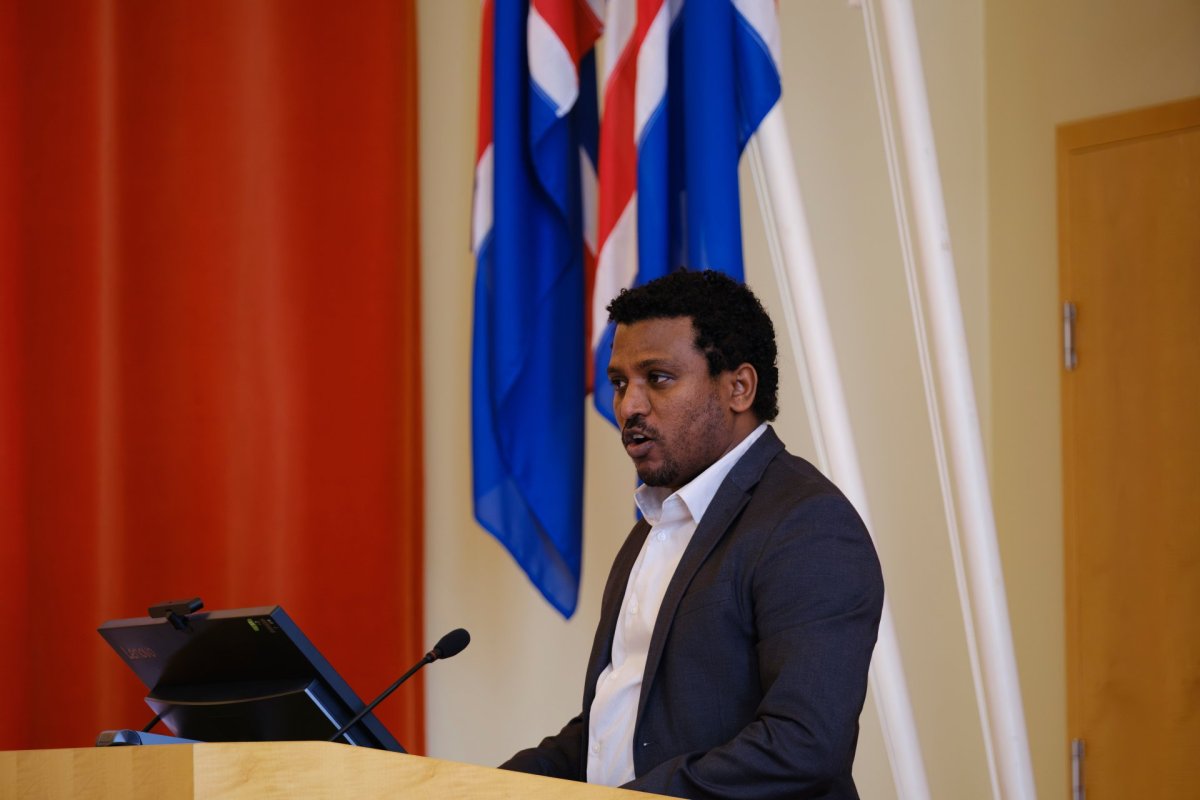
On Tuesday, 3 March 2026, the University of Iceland hosted an open public event titled From Knowledge to Development Impact: Gender Equality under Pressure, bringing together GRÓ GEST fellows and alumni, university leadership, and development partners to examine what it takes to advance gender justice at a time of intensifying global resistance. The event, held in the University’s ceremonial hall, was organised by the GRÓ Centre for Capacity Development, Sustainability and Societal Change, the GRÓ Gender Equality Studies and Training Programme (GRÓ GEST), and the Ministry for Foreign Affairs of Iceland, in collaboration with the Institute of International Affairs. More than 200 people were there in person or followed the live stream.
The central premise was straightforward, but urgent: gender equality progress is neither linear nor secure. In a public statement published in advance of the event, the Minister for Foreign Affairs, Þorgerður Katrín Gunnarsdóttir, warned that rights once seen as “secure and undisputed” are being challenged, and that the world is witnessing how quickly hard-won gains can be reversed. The statement situated gender equality as a cornerstone of Iceland’s international engagement, including its work through multilateral institutions and its current membership of the UN Human Rights Council.
Although the Minister was unable to attend in person due to travel, the Ministry was represented by Martin Eyjólfsson, Permanent Secretary of State, who emphasised that “progress cannot be taken for granted,” describing a global landscape of instability and polarisation in which gender equality must be defended as a foundation for sustainable development, democratic governance, and social stability.
A University Platform and a Global network
In opening remarks, Silja Bára Ómarsdóttir, Rector of the University of Iceland, reflected on the University’s role as host institution since GRÓ GEST was established in 2009. She described the programme’s interdisciplinary profile and its contribution to the University’s academic life through international partnerships, visiting scholars, and a learning environment where diverse perspectives intersect. She also highlighted how GRÓ GEST engages with contemporary global realities, including conflict and shrinking space for rights-based work, through education and public dialogue.
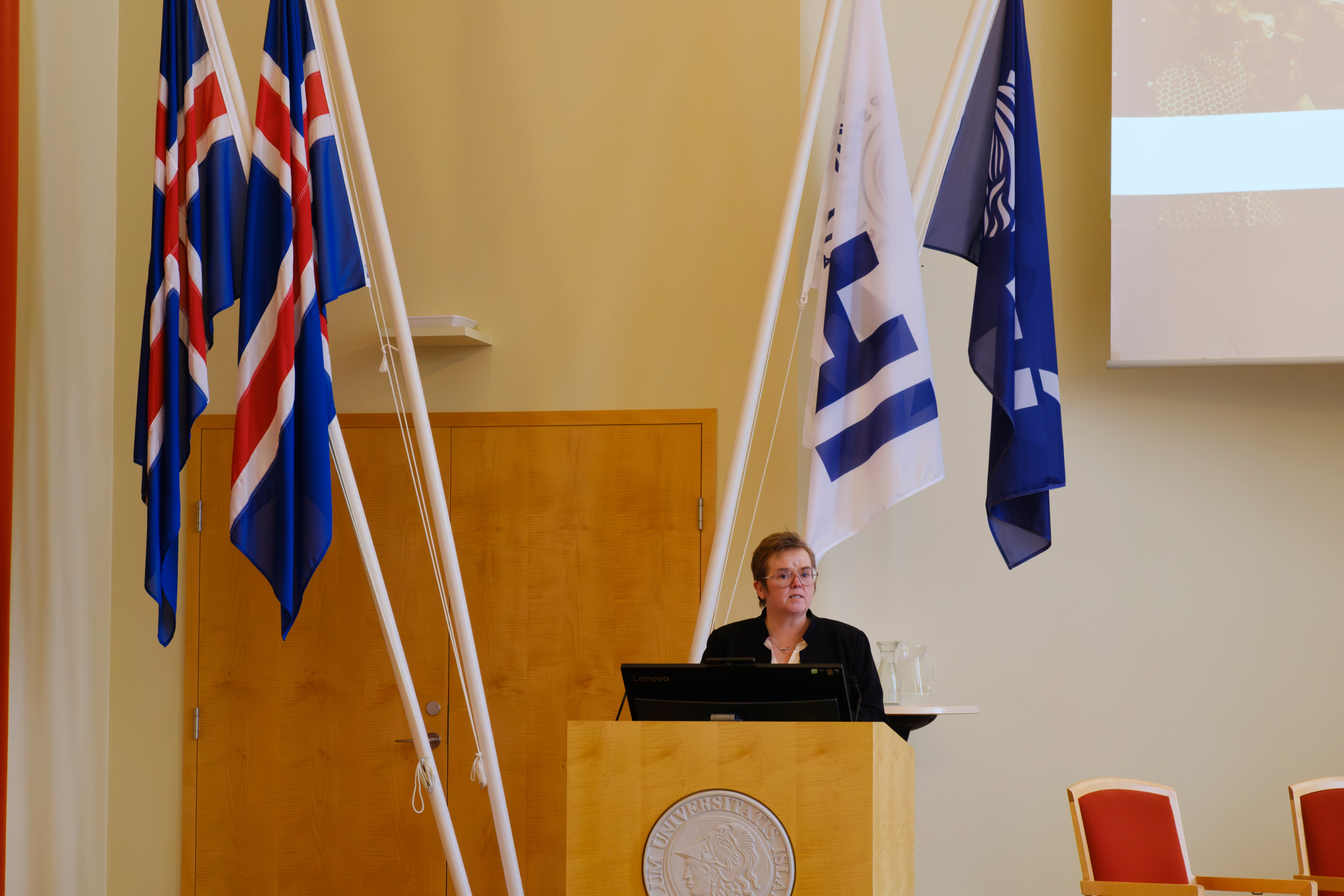
Rector of the University of Iceland, Silja Bára Ómarsdóttir
The event was also part of a wider GRÓ series that aims to move beyond headline figures and ask a deeper question: where do alumni go, and what does knowledge look like when translated into practice? GRÓ GEST has, since its establishment, graduated close to 300 fellows from more than 40 countries, forming an alumni network working across government, civil society, academia, and international agencies. The event’s purpose was not simply to celebrate these numbers, but to examine the conditions that shape whether expertise can be sustained, and whether impact can be realised, once fellows return home.
“Reclaiming gender justice” under Pressure
Irma Erlingsdóttir, Professor and Director of GRÓ GEST, opened her address by naming the political moment directly: “We meet at a time when gender equality is increasingly contested.” She pointed to patterns visible across regions, political retrogression, attacks on human rights, renewed restrictions on women’s rights, and hostility toward LGBTQI+ communities, often amplified through polarising narratives that frame gender equality as external or imposed.
Erlingsdóttir emphasised that GRÓ GEST is not designed as a vehicle for exporting Nordic models. Rather, she described it as a space of transcultural exchange where knowledge is co-produced: fellows arrive as experienced professionals and leaders who bring institutional and contextual insight from complex settings. In this framing, gender justice is fundamentally about power, how societies organise it, legitimise it, and contest it, and education matters because it shapes whether hierarchies are treated as fixed or open to change.
She also connected this philosophy to the programme’s long-term orientation: an alumni strategy premised on partnership, peer solidarity, and alumni-led initiatives, including mechanisms such as the March 8 Fund and blended-learning models adapted locally by alumni. The underlying claim was ethical as well as practical: durable change requires institutional continuity, local ownership, and networks that can withstand backlash.
Keynote: Backlash, Conflict, and the Case for Capacity Development
The keynote address was delivered by Yeshiwas Degu Belay, a GRÓ GEST alumnus of 2017 and PhD scholarship recipient whose research focuses on gendered dimensions of Ethiopian peacekeeping. He placed the discussion within what he described as a global paradox: while decades of advocacy and institutional reform have produced real gains, those gains are being actively contested. “This backlash is not accidental,” he argued. “It is organised, well-resourced, and increasingly transnational,” citing rollbacks on rights and attacks on gender scholarship and feminist organisations.
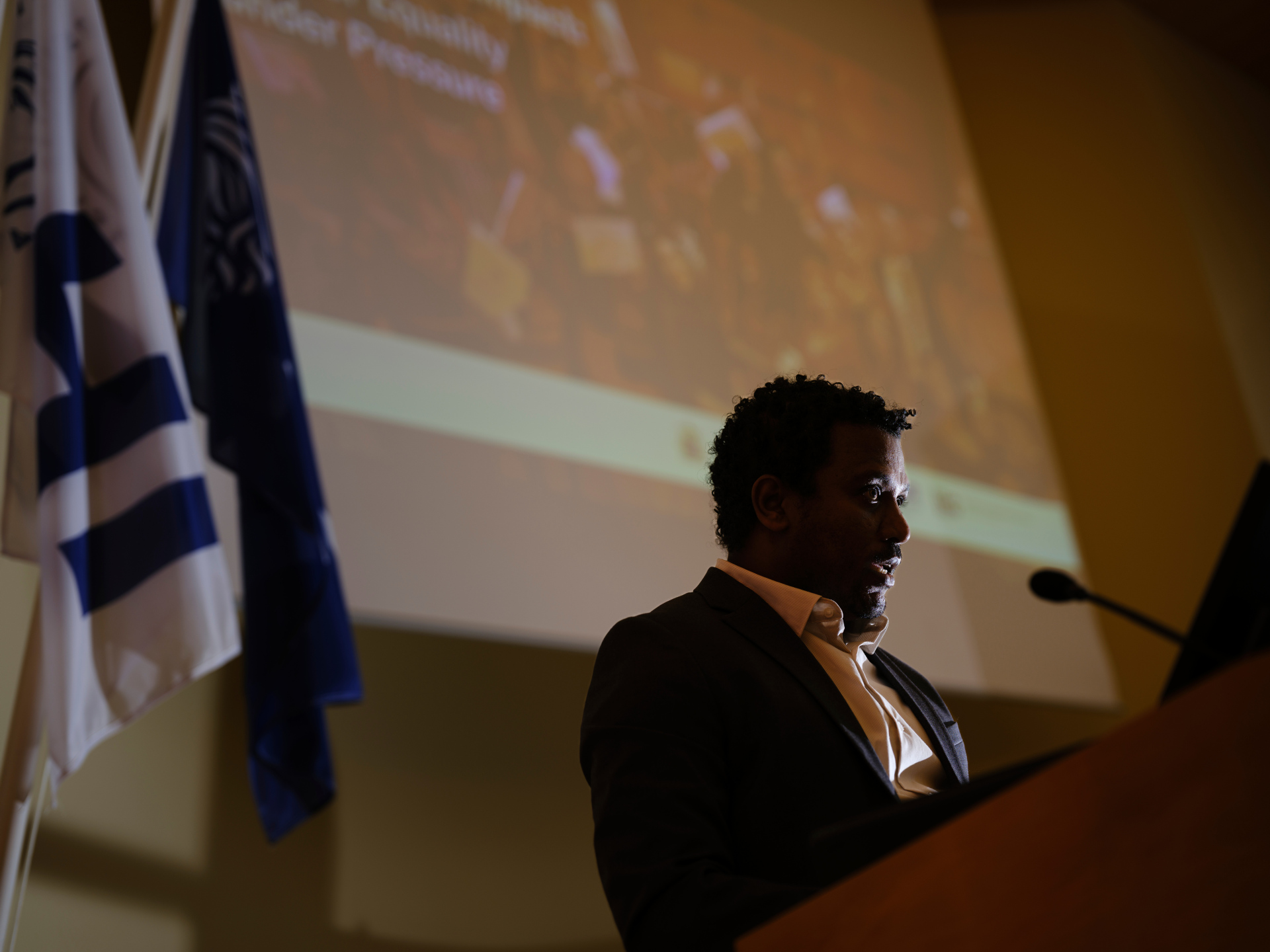 Keynote speaker Yeshiwas Degu Belay
Belay also drew attention to a structural constraint: chronic underfunding of gender equality initiatives and women’s rights organisations, which limits sustainability and weakens local ownership. Linking the gender equality agenda to conflict and insecurity, he described how war amplifies existing inequalities and produces gendered harms that persist long after fighting ends, affecting women, men, and communities through displacement, trauma, militarisation, and ruptured social cohesion.
His concluding argument returned to the event’s central theme: “Capacity development is often misunderstood as training, but it runs far deeper.” In his account, it is the building of ecosystems, communities of practice, networks of solidarity, and shared tools, able to endure beyond political cycles. Such infrastructure, he suggested, is one of the most effective responses available to backlash and institutional fragility.
Alumni Voices: from Knowledge to Practice
Following the keynote, participants viewed a video montage built on 50 submissions from across the GRÓ GEST global network. The snapshots offered a composite picture of how alumni apply gender analysis, human rights frameworks, and practical tools, such as policy advocacy, gender budgeting, programme design, and intersectional approaches, in diverse institutional contexts.
Rather than presenting a single “impact story,” the montage underscored breadth and durability: alumni described work ranging from legislative review and public-sector reform to justice-sector guidelines, grassroots organising, disability rights advocacy, peacebuilding, and institutional gender mainstreaming. The emphasis was not only on what alumni do, but on what sustained learning and networked support make possible over time.
You can view the full video here:
Panel: The Implementation Realities Behind “Impact”
Moderated by Thomas Brorsen Smidt, Senior Programme Manager at GRÓ GEST, the panel discussion moved directly into the practical constraints that sit behind public-facing success narratives. The panel brought together GRÓ GEST alumni: Thelma Kaliu (Co-Founder, GenHub Malawi), Mohamed Altamash Khan (Senior Gender Trainer, Men Against Violence & Abuse, India), Aarti Lila Ram (Deputy Manager, Engro Foundation, Pakistan), and Yeshiwas Degu Belay.
A recurring theme was the growing gap between rhetorical commitment and operational reality. Altamash Khan described a pattern many practitioners recognise: “There has been investment… but the problem is that it has been performative.” Aarti Lila Ram offered a diagnostic used in monitoring and evaluation: “When gender becomes a mandatory paragraph in a proposal, instead of a meaningful shift in practice.” She illustrated how projects can achieve impressive outputs on paper while failing to reach women or shift agency due to weak contextual analysis and inadequate enabling ecosystems.
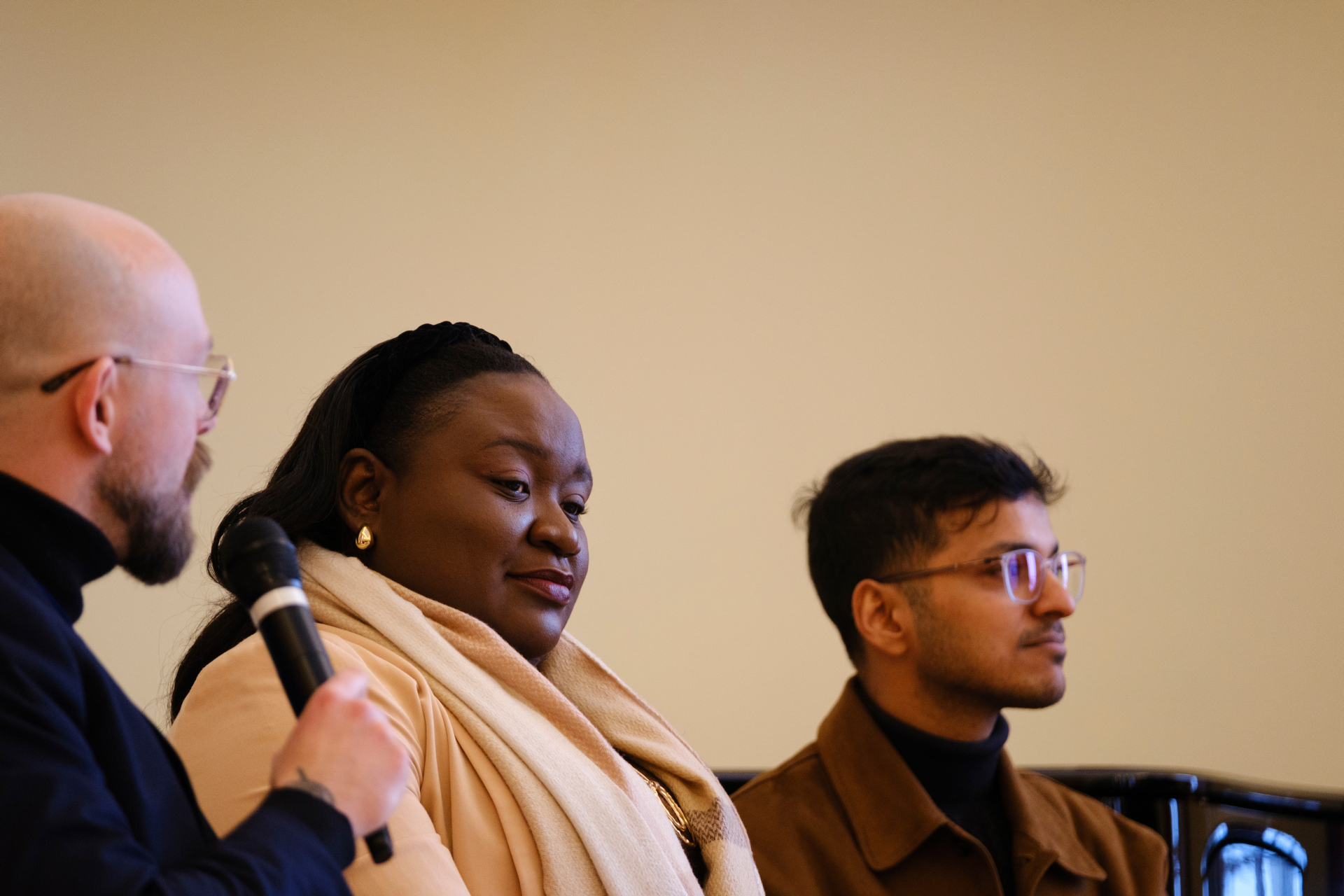
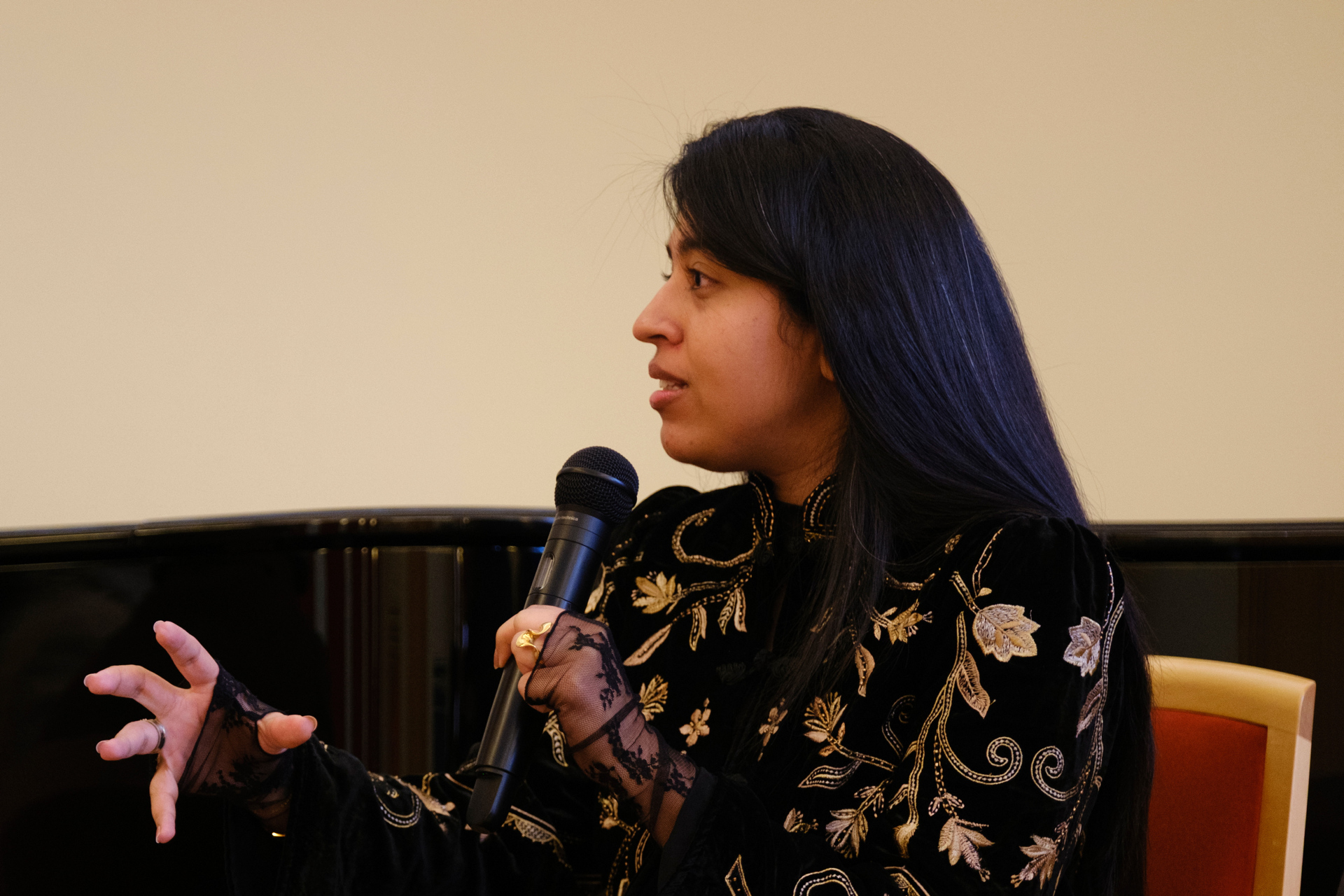
From left: Thomas Brorsen Smidt, Thelma Kaliu, Mohamed Altamash Khan, and Aarti Lila Ram
From Malawi, Thelma Kaliu described the pressures created by funding volatility and the need to redesign approaches for sustainability, shifting from short-term, individualised support toward community-based models that can endure. She also challenged deficit framings that cast Global South communities as passive recipients: “We are equally capable… and we can also teach the West,” calling for a move beyond donor–recipient binaries and toward recognition of local agency and knowledge.
Another thread concerned power in knowledge production. Belay described how global research can position the Global North as the centre of expertise, while scholars from the Global South are treated as “local” or “regional” rather than legitimate global knowledge producers, an asymmetry shaped by funding, institutional location, and authority.
Across contexts, panelists converged on a hard-won insight: negotiation is not peripheral. It is the craft of gender equality work. Whether negotiating the language of a school curriculum, the political acceptability of concepts, or the metrics that define “success,” practitioners described daily efforts to keep substance alive under constraint.
Looking Forward: Networks, Collaboration, and Hope as Discipline
In closing remarks, Nína Björk Jónsdóttir, Director General of the GRÓ Centre, situated the event within GRÓ’s broader purpose: to understand how alumni use training “for the benefit of their societies,” and to learn from the pathways, often uneven and contested, through which capacity becomes impact.
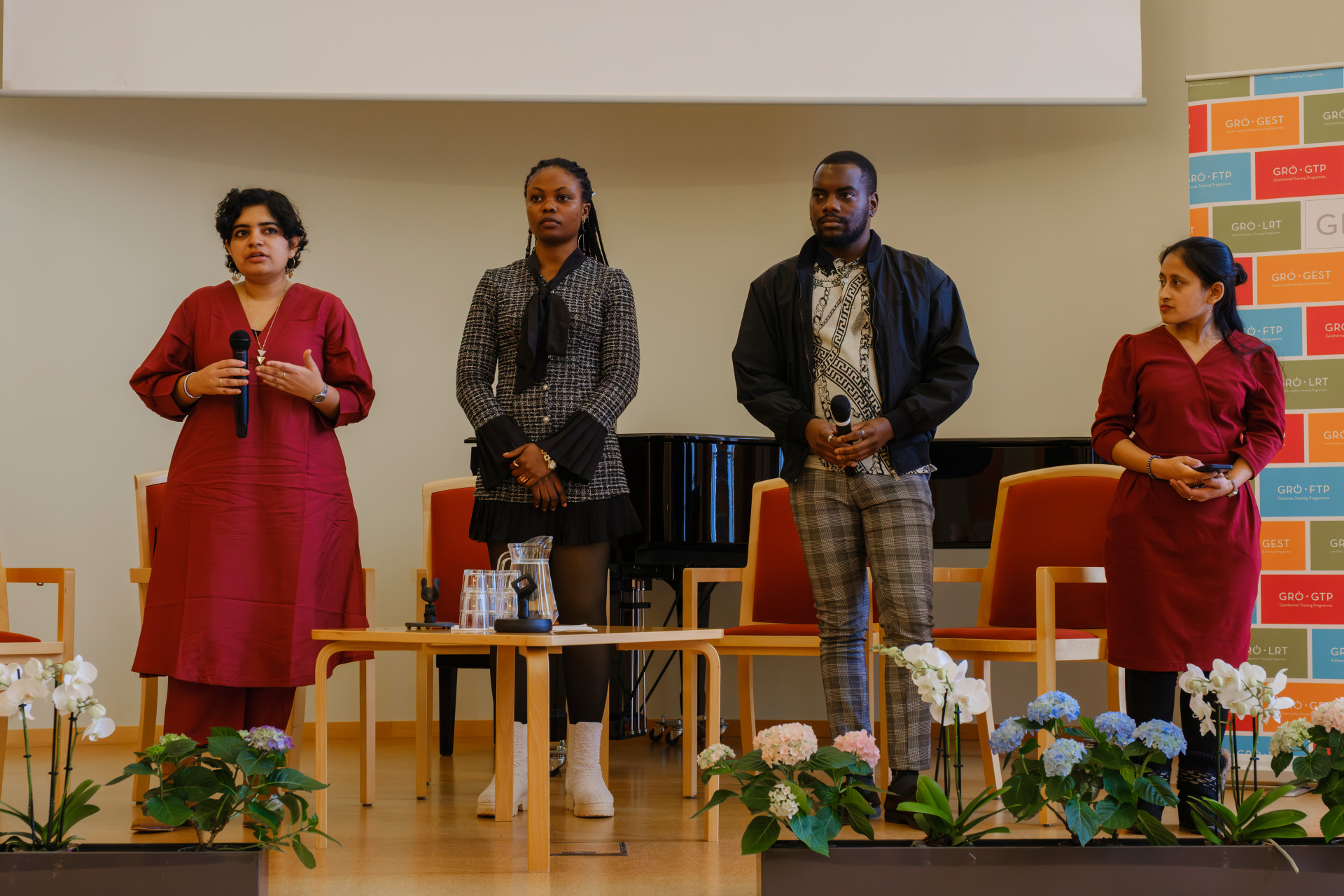
Priyansha Jain (India), Norah Lumnyi Ngwa (Cameroon), Godfrey Junior Malongo (Malawi), and Saniya Giri (Nepal).
The final word came from four members of the 2026 GRÓ GEST cohort: Priyansha Jain (India), Norah Lumnyi Ngwa (Cameroon), Godfrey Junior Malongo (Malawi), and Saniya Giri (Nepal). They framed the moment with a forward-looking insistence on perseverance: “Let the mere act of holding hope be our resistance to the pressures we face.” Their message echoed the event’s underlying conclusion: in a period of backlash, credible gender expertise requires not only knowledge, but networks, institutional strategies, and sustained collaboration across countries, sectors, and generations to keep gender justice politically possible and practically actionable.